Category Archives: Work / University

TU Wien needs feminism!

Reading Time: 2 minutes

Not only I need feminism, but also some of the teachers at my school (TU Wien, University of Technology in Vienna) should do some catching up regarding equality. Want some examples?

I can’t really say if it was pure sexism, but at the compulsory interview before I started studying here, the interviewer (a professor) asked me if I was sure I wanted to “try” this type of informatics studies. It would be tough, there would be lots of maths (you don’t say!) and with my former education I’d be better of “trying” business informatics. Yep, that’s what he said. I’m not sure if he’d asked a male future student with the same background the same question, so I’ll mark it as probably sexist.

Encouraging female future students to study whatever they want: You’re doing it wrong.

Then, at the beginning of 2013, I attended several revision lessons for a course in Formal Methods and Logic (it’s way more interesting than it sounds 😉 ). There were 5 of lessons in all, and I managed to be at 4 of them, missing only the first. A lot of students asked questions, and as far as I remember, most of the people asking were male, and most questions were the same ones, over and over again. The professor was patient in answering, and did a pretty good job in explaining things that were unclear. Until I asked a question that obviously had been answered in the first lesson – that I missed, if you remember – already. I had been the first woman to ask a question. I had been the only woman answering questions that he asked to see if we understood his points. And this is the response I got to my question: “We already talked about that, but I’ll explain it to you. And to show you that we already talk about it, let me show you the example we did. Because you women always need things written down.”

Encouraging female students to ask questions: You’re doing it wrong.

And now, at the beginning of the current semester, our professor in Statistics and Probability Theory thought it would be funny to say the following: “You see, women grow, statistically speaking, 7 years older than men. In Austria, they are allowed to retire 5 years earlier than men. And then THEY are asking for equal rights?”

Statistics: You’re doing it wrong. As a Statistics teacher. Oh my.

I and one of my friends sent this teacher one email each, asking him not to make “jokes” like that again. My (male) friend received an invitation to the teachers’ office during his office hours, to talk about “your problem” (quote). I received an email saying “Sorry that you thought it was meant like this, I didn’t mean it this way. I only wanted to ask the question of equality.” (quote)

Equally responding to emails: You’re doing it wrong.

Also, he said the exact same thing during the next lesson. And since then, he’s taking every chance he gets to make fun of feminism by adding “I hope that wasn’t sexist” to pretty much every example he uses.

Learning: You’re not doing it. That’s why TU Wien needs feminism.

I need Feminism, because …

Reading Time: < 1 minute

… I am a student at a University of Technology.
… I am a student in the area of Computer Sciences.

… there are still to many people who ask “What do we need Feminism for?”

I’m thinking about creating a regular get-together for female students in my field, but also women at TU Wien in general. Unfortunately, many of them don’t think they need an all-female network – just like I thought until about half a year ago.

I don’t remember what incident it was that made me change my mind. The most important thing is, though, that I decided to attend the Vienna FemCamp, a BarCamp dedicated to women and their problems, focussing on online aspects.

I met great people there, and the same goes for the FemCamp in Linz a couple of months later. Things that were discussed there made my realise that until now I had been lucky, for I had never had any real problems with sexism, aside from two things that happened at University.

So yes, I need Feminism. And I’m looking forward to finding other women at my University who would like to meet up every once in a while to talk about what it means being a woman in Technology.

Finally: I’m a ‘real’ student!

Reading Time: < 1 minute

After 4 semesters, I finally completed a course students at our University are supposed to complete within the first 2 semesters. The problem is not that it was sooo difficult – it’s that I’m sooo lazy 🙂

I feel like Pinocchio must have felt after he finally became a real child – I’m a real student now, and can attend whatever courses I like! Only my own laziness now stands in between me and the progress of my studies 🙂

Helping first-year students

Reading Time: < 1 minute

After meeting lots of great people who dedicate part of their time to assisting students in studying – as in, suggesting interesting courses, helping with legal problems, and so on – I decided to finally join them this year.

In order to organise a “Tutorial for First-Year students” (EsTut in short), I was invited to a workshop where we would talk about our ideas, our fears, our aims for those EsTuts, and try to organise at least the first session. Also, we talked about and planned how to advertise our EsTuts.

And what should I say … that weekend was amazing.

I spent 4 days with people I knew a little from University, and some whom I had liked from the start, some who had been a bit weird in the beginning, but all pretty nice people. I got to know them better, and I liked what I saw. Our coaches didn’t put a lot of pressure on us, but still there was a lot of output. Both our coaches said they had rarely seen a group of people so confident and considerate. Everybody got to share their opinions on all kinds of topics, everybody got to share their knowledge, so everybody learned something new during that weekend. At the same time, no drama happened. No arguments or fights broke out. We had (sometimes passionate) discussions, but that was that.

I felt all fluffy inside after that weekend, and I still feel great now when I think about this weekend.

And, the best thing is: in a couple of weeks, I will help students from all over Austria, probably even from other countries, to get to know Vienna, the city I love.

Two nutshells

Reading Time: 2 minutes

I like recaps. They give me the possibility to think over stuff I’ve done. Also, I’m not one for blogging all the time, as you might have seen. It’s more like sitting down once a month (or every 6 weeks), thinking about what I’ve accomplished or what has happened since the last time I wrote – and then write about it.

So here is my 2012 in a nutshell.

I finished my first semester as a student at University. Not very successful, but also not without success.

We had an awesome winter with lots of snow, and I went skiing both with my parents and Georg, and there was terrific traffic chaos everywhere (I remember pictures of roads in Tirol and Vorarlberg, covered in 1-4 meters of snow!).

I spent 3 weeks in the US and Canada, making new friends and relishing every minute of it.

When I came back, I bought a bike, Maya, and set on discovering Vienna by bike. And: a cat café had just opened in Vienna, and the BBC featured me in a fluff-piece about it 🙂

I decided to go for a 10-day hike in my holidays.

I finished my 2nd semester as a student – again, not as successful as I could have, but good enough.

There was, of course, Vienna Calling 2012.

I did a lot of hikes in preparation for The Big Hike, and worked at Vienna Zoo during summer break. Also, in August I moved in a shared flat with Stefan, and had a lot of doubts about me being at University.

Then, autumn already. I was incredibly motivated, and did a lot of work for University. Georg moved in with us (yes!), and then … somehow … already it was Christmas.

There was big get-together with old school mates (from more than 10 years back), meeting and visiting relatives and friends, and after one week, I was happy to return back to Vienna.

So this was 2012 in a big nutshell (coconut like).

2012 in a smaller nutshell: it brought lots of new friends, finally seeing old friends again, discovering Vienna anew time and time again, seeing new things in Austria and also visiting new places all over the world. And of course, lots and lots of new things learned.

Let’s hope, 2013 will be like this – or even better.

Uni: Good news.

Reading Time: < 1 minute

Some days ago, I wrote about how University is trying to get rid of students (see “Uni-jam-ity”). For me, this meant I had to pass 3 exams in order to finally finish the first phase of my studies. One of them was especially critical, as it could have meant the end to my studies in case I did not pass.

Good news: I passed them all. One (not critical) with 12 out of 20 points (60 %), one (also not critical) with 20 out of 25 points (80 %), and the critical one with 47 out of 72 points (65 %). The one I passed with 80 % was the first (of three) programming exams. I’m pretty proud of that one, because the 80 % mean that the whole programme did exactly what it was meant to do 🙂

Uni-jam-ity

Reading Time: 2 minutes

A lot of foreign students in the last years and decades wondered how the Austrian educational system works: everybody, after passing their Matura (A-levels or anything comparable to it) was allowed to study at Austrian Universities. Except for some studies (like medicine, where there always were knock-out exams at the start to filter the masses of aspirants), all studies were open to everybody. And nobody had to pay a cent of tuition fees.

Now, it’s no wonder that everybody asked themselves how this could work. And of course, it doesn’t.

Last year, the public was informed that – amongst others – the University of Technology in Vienna was nearly broke. Students and professors got together to find ways to help the University. Government did nothing. And the University … found ways to lessen the number of students, because “it’s the students who cause most costs”. Also, this way, the professor-student ratio would be improved to a level closer to international standards.

Now how does that work?

The Department for Informatics, the first one to completely run out of money, and also the one I’m studying at, was the first to invent the so-called “Eingangstests”, which nothing else but exams to filter the “too much” of students. 700 people sign up for the 5 kinds of IT studies at UTV every year –  but there is only space (= money) for 375. But instead of having one test to check all required skills and knowledge at the beginning of the semester, there are several tests: one for each course. And they happen 4-6 weeks after the semester has started – so if you discover that either you don’t like IT enough to study it, or you just don’t manage to pass the exam, there’s no way of changing to another study now. You just lost one semester.

This set-up cut down inscriptions by about 10 % (guessing from the number of people who signed up for a 1st-semester course I’m attending). Also, it decreases the motivation for many a student extremely: for example, in one week, there were 3 exams to prepare for. One of them happened Monday morning, 7 am. Over 200 people decided not to partake in that exam and rather focus on the other two (or one of them).

Congratulations, Mr Steinhart (our dean, who had the brilliant idea of Eingangstests). Your system seems to work. Also, government decided to legalise these exams and allowing for other Universities and other fields of study to implement them, too.

Museum recap: Technical Museum

Reading Time: < 1 minute

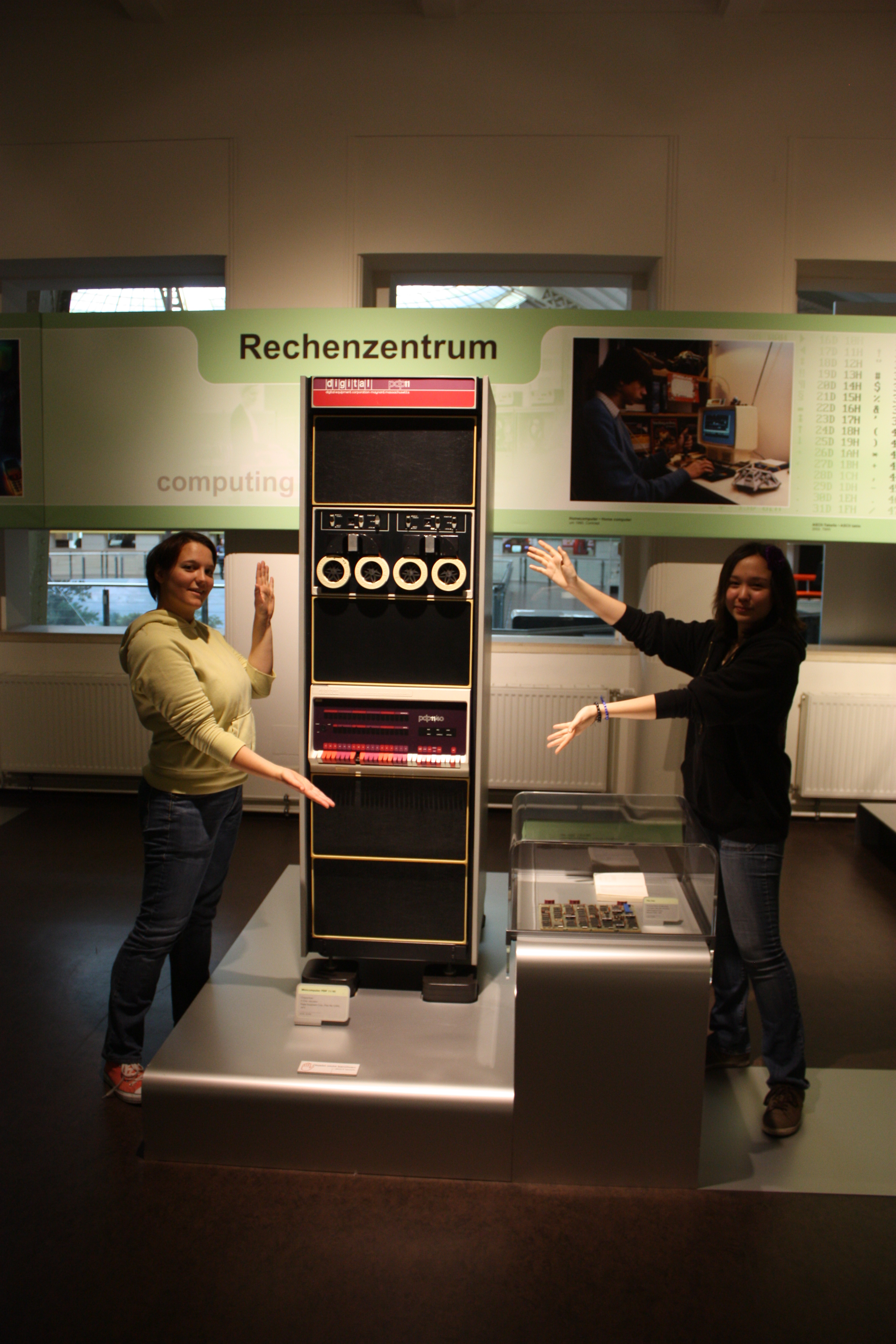
To accomplish one of the many exercises IT students have to complete for a positive grade in “Gesellschaftliche Spannungsfelder der Informatik” (roughly “Areas of conflict in between Society and IT”), we had to pay a visit to the Technical Museum in Vienna. We, that’s me and a couple of friends from University, and we had a great time at the Museum on April 20th.

Enjoy the pictures of some grown-up nerds, childishly exploring and enjoying the museum!

Would that I had known …

Reading Time: < 1 minute

… that there is this awesome online course by Stanford University, called “Programming Methodology”. Had I known some months ago, I might be way further in my progress on Programming at Uni.

If you’re interested in learning how to programm in Java, go and see the lecture videos. You’ll find the links to them and also to all handouts on the course’s website.