Category Archives: Work / University

Write-Up: Bias in Algorithmic Systems

Reading Time: 7 minutes

So, here comes the final write-up I handed in this summer for the Critical Algorithm Studies course. The course is really cool, and if you have the chance to do so, I absolutely encourage you to enroll. Last semester, we looked at algorithmic systems, and how they (re)produce bias, from various viewpoints (it’s possible that the approach changes for next year).

Continue reading Write-Up: Bias in Algorithmic Systems

Seminararbeit: Repräsentation von Gender in Science Fiction

Reading Time: 13 minutes

The following text is a term paper I wrote in the spring term of 2015. The class I wrote it for is called “Rätsel, Erkenntnis, Wissen: Kulturelle Macht der Wissenschaften” (roughly translated: “Puzzle, Insight, Knowledge: Cultural Power of Sciences”). It is taught by Amelie Cserer every spring term at TU Wien as a soft skills/transferrable skills course. The description sounded very interesting to me, and the first session just made me more intrigued. You may notice that the teacher used the plural form of Wissenschaft (science) – she told us in the first session that this was kind of a statement to show that there is no such thing as “die Wissenschaft” (“the (one and only) science”), although people tend to use the word that way.
Continue reading Seminararbeit: Repräsentation von Gender in Science Fiction

Role Model Sunday: Margaret Hamilton

Reading Time: 3 minutes

Portrait of Margaret Hamilton, 1995This woman’s story could be found in my (and probably your) facebook stream for a couple of months, on and off. The picture I’m posting here is way more recent than the famous one used in all the postings telling us about her greatest achievement, so you probably didn’t recognize here. The famous picture is that of a young woman, wearing big glasses and a striped dress, proudly smiling into the camera, standing next to a huge pile of documents.

Meet Margaret Hamilton, the woman who sent the Apollo mission to the moon (and back again).

Margaret Hamilton had a B.A. in mathematics from Earlham College, and after teaching highschool mathematics for some time, she and her husband moved to Boston. The plan was for him to finish his graduate studies, while Margaret would be working to sustain them both, in order to finish a graduate programme in mathematics when he was done with his.

Hamilton popularized the term “software engineering” (coinedby Anthony Oettinger), and was one of those who developed important software concepts. Some of these are priority scheduling, end-to-end testing, and human-in-the-loop decision capability, such as priority displays.

As a working mother in the 1960s, Hamilton was unusual. She would bring her daughter Lauren to the lab on weekends and evenings. While the 4-year-old slept on the floor of the office, her mother programmed away. She loved the novelty of her job (“like the Wild West” is a term she used in an interview), and also liked the camaraderie. There were after-work drinks at the MIT faculty club, geek jokes and the like. At the lab, she said, she was “one of the guys.”

In 1965, Hamilton became responsible for the onboard flight software on the Apollo computers. Sometimes the pressure kept Hamilton up at night. Once, after a party, she rushed back to the lab to correct some code she’d suddenly realized was flawed. “I was always imagining headlines in the newspapers, and they would point back to how it happened, and it would point back to me.” (WIRED)

One day, when Hamilton’s daughter Lauren was playing with the MIT command module simulator’s display-and-keyboard unit. As she toyed with the keyboard, an error message popped up. Lauren had crashed the Apollo simulator by somehow launching a prelaunch program called P01 while the simulator was in midflight. There was no reason an astronaut would ever do this, but nonetheless, Hamilton wanted to add code to prevent the crash. That idea was overruled by NASA.  They told Hamilton and her team over and over that astronauts were trained to be perfect, so they would never make that mistake. She wanted to add error-checking code to the Apollo system that would prevent this from messing up the systems. But that seemed excessive to her higher-ups. “Everyone said, ‘That would never happen,’” Hamilton remembers.

But it did happen. Five days into the historic Apollo 8 flight which brought astronauts to the moon for the first-ever manned orbit, the astronaut Jim Lovell inadvertently selected P01 during flight. This wiped out all the navigation data Lovell had been collecting. Without that data, the computer wouldn’t be able to calculate and execute the route back. But Hamilton and her team developed a plan based on her program note regarding the problem, and thanks to that —and Lauren—the Apollo astronauts came home.

Sources for this article:
LOL, WTF?

Reading Time: < 1 minute

3 months without a post. Wow, that’s bad!

A short update on what I’ve been up to:

  • doing research for my bachelor’s thesis
  • work (10 hours per week maximum) on Eurographics Workshop VCBM, happening NOW.
  • general uni stuff
  • wrote a wikipedia article for Ina Wagner(still needs translation into English)
  • lots of stuff at/with/for the Student’s Union
  • 3 weeks of vacation in Italy, including lots of geocaching (current status: 460 found!)

So my plan for the next week is to get the pictures from Italy sorted and write about that a bit.
Also, if you want to see what happens during the next days, follow the vcbm twitter account that I’m curating!

Role Model Sunday: Rosza Peter

Reading Time: 2 minutes

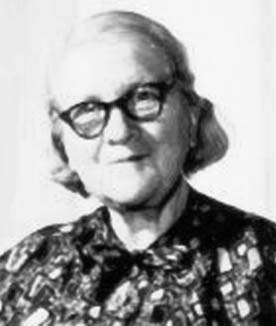
For this week’s Role Model, my thanks go to the women’s department at TU Wien’s Student’s Union. Part of their campaing for yesterday’s International Women’s Day was to rename some of the most used lecture rooms at TU, giving them names of female scientists. This is how I found today’s Role Model: Rózsa Péter.

Péter Rósza. (picture from wikimedia, copyright expired)

Rósza Péter attended Pázmány Péter University (the oldest and largest university in Hungary, later renamed Eötvös Loránd University) starting in 1922. She at first wanted to study chemistry, but soon discovered that her true passion lay with Mathematics. Graduating in 1927, she started to work as a tutor and teacher at high schools, but also started her graduate studies.

Begin told about Gödel’s work on incompleteness, she started to work on her own proofs in the field, focusing on the recursive functions used by Gödel. She published several papers, proposing to treat recursive functions as a seperated sub-field of mathematics, making her one of the founders of this field of mathematical research. In 1935, she received her PhD (summa cum laude).  As of 1937, she was a contributing editor at the Journal of Logic.

When the Fascists took over in Hungary in 1939, Rósza Péter lost her permission to teach, due to her jewish roots. Still researching and writing during the war times, she published “Playing with Infinity” in 1943, where she discussed number theory and logic for lays.

In 1951 she published a monograph, Recursive Functions, and in 1955, she became a professor at Eötvös Loránd University (her renamed alma mater), until her retirement in 1975. In 1976, she published Recursive Functions in Computer Theory. This book was the 2nd Hungarian book on mathematics to be published also in the Soviet Union, as the matter was considered essential to the theory of computers.

Some information can be found at wikipedia,and the websites of Agnes Scott College and the San Diego Supercomputer Center published short biographies referencing more interesting sources, too.

Computer Sciences, Social Sciences and Feminism

Reading Time: < 1 minute

It started out as a joke. A friend and I attended a lecture together, a lecture on Social Informatics, which was pretty … well, not up-to-date considering the materials and examples that were used.

So one evening we decided we’d hijack part of the lecture that would take place the next day. The lecture room would be open for us from 11 am, with the professor usually arriving at 11.20 am – so why not use those 20 minutes, during which students would already be there, or at least be arriving, to talk about something more up to date than airplane crashes from the late 1990ies?

Continue reading Computer Sciences, Social Sciences and Feminism

Small plans instead of big resolutions

Reading Time: < 1 minute

Most people have one big New Year’s Resolution, and struggle with it. A way better idea that I heard during my stay at my parent’s place, in a Sunday morning interview with one of my favourite authors, Thomas Brezina (wikipedia), is the following:

Don’t make one big resolution. Try to think of a couple of things that you’d like to do during the upcoming year. Write them down, and during 2014, check every once in a while how you are doing on completing those plans.

So here are my plans for 2014:

  • find about 170 geocaches, so my total will be at least 500 by the end of 2014
  • walk another 2 parts of Lechweg with my mum
  • hike up Säuling, a mountain near my hometown, also with my mum
  • finally complete the trail that goes all around Vienna (“Rundumadum”)
  • make use of my Niederösterreich Card
  • complete courses worth 30 ECTS per semester, so I’ll finish my Bachelor’s degree within 8 semester in sum

and of course, the classic thing: restart going to Yoga and Gymnastics classes on a weekly basis.

Did you make a resolution? Or do you have plans, like I do?

Sexism: Visibility vs Existence

Reading Time: 2 minutes

This is a post that I’ve been thinking about since … well, 2 months. The title tells it all, it’s again about my post on what I have encountered at TU Wien that I regard as sexist. For the sake of completeness, here’s also the link to my addendum to that post (in case you missed it).

So, that blog post of mine seems to have made it as far as to the Austrian Students’ Parliament – yay! Also, it seems to have made quite an impression wherever it went.

Apparently the message heard by some people was that there is “a lot of sexism over there at Informatics”. It seems to me there are people out there who think what they don’t see doesn’t happen, as in “if nobody says there’s sexism at MY department, there is no sexism here”.

Maybe you’re not paying enough attention. Maybe your “sexism radar” hasn’t been fine-tuned yet. Maybe you’re just a hell of a lucky person who happens to be at a department where there are no sexist persons.

I’m a nice person, so I hope for you that it’s number 3. On the other hand, if you ever happen to be thrown into another environment, with less nice and less feminist persons, you’ll have a pretty tough time either getting accustomed to it, or – which I hope you’re already doing – changing it.

Making sexism visible as what it is – prejudice and discrimination based on a person’s gender and the stupid belief that one gender is overall superior to the other, thus making it alright to dominate the seemingly weaker gender – is the first step of making it go away.

And that’s what I was hoping for. Raising awareness that there’s still much to do at TU Wien. Finding allies. Maybe even starting something that might end up in changing my University.

Vienna 101, continued

Reading Time: 2 minutes

Showing the city I love to people who are new to it or want to discover new places – I LOVE it 🙂

As everybody at the first meeting liked the idea, we visited Zentralfriedhof on our second trip. I changed my usual tour a little, so we would see different parts of the cemetery, including the old Jewish cemetery where I don’t go that often. We also checked off some Geocaches that had been placed at the cemetery after my last visit.

Our third visit to Places You’d Usually Don’t See Or Visit In Vienna was to Lainzer Tiergarten. Unfortunately, most of the park is closed in Winter, due to all the game living there and their need of having a quiet time during the cold season. So instead of having a rather long hike starting in the North of the park, and having a great view over the city, we spent most of the Tutorium on the tramway and waiting for it – but the small part of the park that was open was definitely worth it! That part is called Hermesvillapark, and that Villa is a lovely piece of bavarian Kitsch in the middle of a lovely area –  built by Emperor Franz Joseph for his beloved Sisi.

We tried solving a multi stage geocache, but didn’t succeed. Obviously 3 informatics students can’t count letters as good as a 7 year old girl (we met a geocaching family along the way, and they had a different outcome, and logged the cache … ). Later on, we DID log a traditional geocache, so bringing the GPS device wasn’t totally futile 🙂

Last but not least, trip number 4 took us to Heeresgeschichtliches Museum (HGM, Museum of Military History). Every year, usually on the first weekend of advent, there’s a medieval market happening outside the museum, and the entrance to the museum is free of charge. This time, only 2 of our usual participants came, and even Boki didn’t have time to come. I decided to also invite some other friends and acquaintances, but still we only were 4 people 🙂  We learned some things about Austria’s wars from 17th to 19th century, about fencing in the 14th century, fashion in the 13th century, and about the area where HGM is located (called “Arsenal”). Of course we also tasted a couple of punch variations and logged a geocache. I sure am happy that people don’t mind, or even enjoy, my hijacking the Tutorium for finding geocaches 🙂

Vienna 101, lesson 1

Reading Time: < 1 minute

As I mentioned before, I’ll be a tourist guide for students who just moved to Vienna, or would like to (re)discover Vienna, this semester.

Unit 1 of the “Wien-Tut” was an easy walk from our University’s main building at Karlsplatz to Stephansplatz (aka, the city center) and then we had a coffee and talked a bit about what they wanted to see in the next unit.

Well, that’s the extra-short version of it. Along the way, Boki and I showed them the Opera, the Albertina museum, the Crypt of the Habsburgs, Stock-im-Eisen-Platz, and my personal favourite in the first district: Blutgasse. The unanimous feedback was that the students want to see more of the unusual sights, sites and sides of Vienna, just like Blutgasse – so we decided we’d go see Zentralfriedhof cemetery next.

It’ll be great 🙂